 One of the earliest 'thrillers' was Harold Lloyd's ‘Safety Last’ in 1923, featuring an American boy performing daredevil stunts on the side of a skyscraper. The haunting and chilling German film entitled simply ‘M’ broadcast in 1931, starred Peter Lorre as deviant a child killer. The film's story was based on the life of serial killer Peter Kurten. Various horror films of that era included, The Cat and the Canary, Rouben Mamoulian's Dr. Jekyll and Mr. Hyde, and The Bat Whispers, all created during the early thirties to mid-forties.
No list of thriller
 films can be complete without mentioning English film-maker Alfred Hitchcock. He helped to shape the modern-day thriller genre, beginning with his silent film The Lodger created in 1926, a Jack-the-Ripper type story full of mystery and suspense, followed by the thriller Blackmail in 1929, and his first sound film. Hitchcock, from this point, makes a signature cameo appearance in his feature films, beginning with his film ‘The Lodger’. After 1940, he appeared in every film he made, except for The Wrong Man in which he starred in silhouette narrating the prologue, critics say it was to highlight the fact that, unlike his other movies, the film was based on a real person and is a true story.
 “Alfred Hitchcock was the king of the thriller movie; no one has ever been able to
 pull off the type of success he found as a director. Psycho, released in 1960, was definitely one of Hitchcock’s finest films.” –The EchoAlfred Hitchcock is considered the master of the thriller genre, understanding his audience's fears and desires, using them to his advantage, and taking viewers into a state of association with the representation of reality facing the character. He would often interweave a taboo theme into his films, such as the latent homosexuality in Strangers on a Train, voyeurism in Rear Window, obsession in Vertigo, and the twisted Oedipus complex in Psycho.
 Modern th
 riller films tend to follow the ideas of espionage and action, mainly inspired by the movement of the 007, James Bond films. Although the series of movies started off as crime thrillers they have now morphed into films which focus more on the impressive technology and action. The only thing that hasn’t changed is the concept of the Bond girl, yet their roles in the film have progressed to be more socially acceptable with the evolution of the modern female image. The first Bond film featured Ursula Andress, a blonde, thin beautiful woman with a dangerous side, her famous scene in which
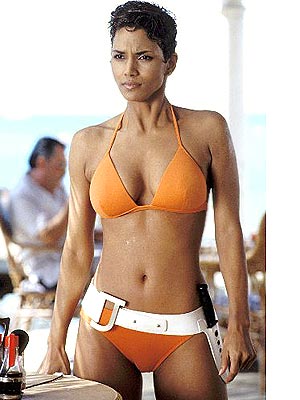 she emerges from the sea waters has gone down in history as the sexiest bond moment, and that is exactly what the makers of the Bond films want, sexy characters to remove the monotony of crime thriller films. For exactly this reason, forty years later Halle Berry was cast as the Bond girl for the 2002 “Die another Day” (Halle Berry making history for being the first non-Caucasian woman cast as a Bond girl). In examining the pictures of their performances when first meeting Bond the similarities are striking, even down to their stance. Their clothing is of the same style, body shapes and the bladed article attached to their left hip. Although the ideas of Bond thrillers have changed, the ideas that make them of the distinct thriller genre haven’t.

No comments:
Post a Comment